Designing, Building, and Launching a SaaS Product
Javi is a production management platform I designed, built, branded, and launched entirely on my own. It helps video and photo production teams manage the parts of the job that live outside the edit: tracking gear, planning shoots, coordinating crews, and keeping equipment accounted for across locations.
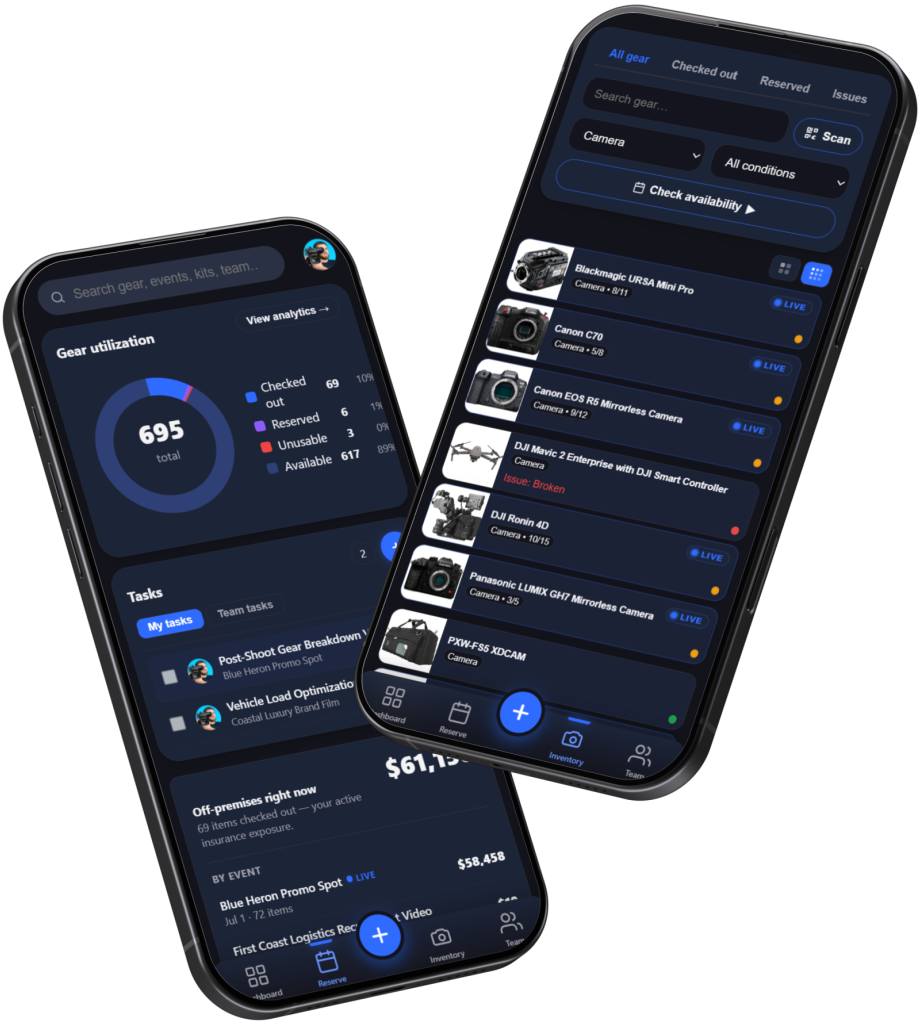
Overview
The idea came directly from the work. After years of running productions, I kept watching the same problems repeat: gear that couldn't be found, spreadsheets that were out of date the moment they were saved, and no clear answer to "who has the camera?" I built Javi to solve the problem I'd lived with for a decade, and turned it into a real, subscription-based product available on the web, iOS, and Android.
I've built Javi entirely as a side project, working nights and weekends around my full-time role, and it's ongoing. It's live, in real users' hands, and still actively growing as I add features and refine it.
This project is different from the rest of my portfolio. It wasn't a video or a campaign. It's a company: strategy, product design, branding, full-stack development, and go-to-market, handled end to end by one person, on my own time.
My Role
I was the sole creator: founder, designer, developer, and marketer. Every part of Javi, from the database schema to the logo to the words on the pricing page, is something I made.
Primary responsibilities included:
Product strategy and defining what to build, and what to leave out
Brand identity, including logo, visual system, and voice
End-to-end UX and UI design across web and native apps
Full-stack development of the entire application
Building the marketing site and writing all of its content
Pricing, subscription billing, and launch
Wearing every hat at once meant every decision, creative and technical, had to serve both the craft and the business.
Type of Work
Building Javi pulled together nearly every discipline I work in, plus several I taught myself along the way:
Product design — information architecture, user flows, and interface design for a complex, data-heavy tool that still had to feel simple
Branding — a distinct identity built to feel modern and production-native rather than like generic enterprise software
Full-stack development — a complete web application with native iOS and Android apps, real-time data, authentication, file storage, and integrations
Marketing and content — the website, feature and industry pages, a full resource library of guides and how-tos, and email
Systems thinking — billing, subscription tiers, notifications, and third-party integrations with tools like Asana and Basecamp
Partnerships — pitching, meeting with, and integrating a major retailer (B&H Photo) to power the product's gear catalog
Design & Brand Approach
Most gear-management software looks like a spreadsheet with a login. I wanted Javi to feel like it was made for creative people, by someone who understood the work.
The brand leans into a clean, confident, production-native look: a dark interface, a single strong accent color, bold condensed type, and a design language that treats the people using it like professionals, not warehouse clerks. The guiding principle throughout was "bigger, simpler UI," fighting the natural tendency of a feature-rich tool to become cluttered, and keeping the experience calm even as the capability grew.
That same voice carries into the writing. Every page speaks the language of someone who's actually been on a set, because I have.
Development & Technical Approach
Javi is a full production application, not a prototype. I taught myself to build what the product needed:
A complete web app backed by a live database, with real-time updates so a team sees the same information at the same time
Native iOS and Android apps, including push notifications
QR and barcode scanning for checking gear in and out
Subscription billing with multiple plan tiers
Role-based access, so studios, contractors, and clients each see exactly what they should
A custom gear search engine powered by B&H Photo's product catalog, which I secured by reaching out to B&H directly, meeting with their team, and building the integration myself, so users can add real gear with accurate photos, specs, and values in seconds
Integrations with the tools teams already use, and a bulk import system that lets users build an entire inventory in minutes instead of days
A defining part of this project was learning to build alongside AI. I taught myself to work with Claude Code as a genuine development partner, using it to design and ship features, wire up integrations, debug live issues, and move through unfamiliar technical territory far faster than I could have alone. That meant learning how to direct it well: how to break a problem down, give it the right context, catch its mistakes, and know when to push back. The skill I walked away with isn't just Javi. It's a repeatable way of using AI to compress the distance between an idea and a working product, and to learn new tools and disciplines on the fly. It's changed how I approach nearly every project since.
The technical side had to disappear behind the experience. The goal was never to show off the engineering; it was to make a genuinely hard set of problems feel effortless to the person using it on a shoot.
What Made This Project Different
Javi represents something I'm proud of in a different way than my production work: it's proof that I can take an idea from a blank page all the way to a shipping product, owning the strategy, the design, the code, and the story around it.
It also meant operating like a founder, not just a builder: when the product needed a real gear catalog, I reached out to B&H Photo, met with their team, and integrated their catalog into a custom search engine of my own, turning a cold outreach into a core feature.
It draws on everything, my decade of production experience to know what to build, my design background to make it feel right, and a self-taught engineering skill set to actually build it, all developed after hours around a full-time job. Most creative directors can art-direct a product. Fewer can design, build, brand, and launch one alone, at night, and keep it running. Javi is where all of it came together, and it's still going.